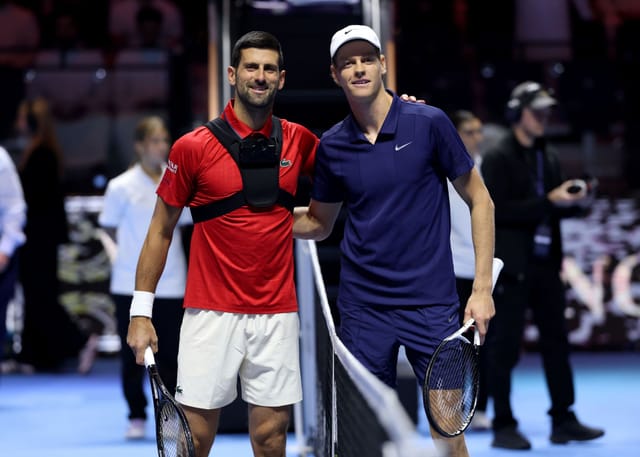
After Novak Djokovic, Jannik Sinner & Co.’s complaints, ATP forced into new Heat Rule change for 2026
The conditions in Shanghai and several other ATP events this season proved challenging, causing visible frustration for top players like Novak Djokovic and Jannik Sinner. At the 2025 Shanghai Masters, temperatures climbed beyond 30°C with intense humidity. The extreme weather took its toll, forcing Sinner to retire mid-match due to heavy cramping, while the 24-time Grand Slam champion struggled with exhaustion and vomiting.
Beyond those two stars, Daniil Medvedev also dealt with severe cramping during his fourth-round match against Learner Tien. Meanwhile, Denmark’s Holger Rune openly criticized the ATP, raising questions about the enforcement of heat-related regulations.
“Why doesn’t the ATP have a heat rule? You want a player to die on the court?” Rune said. “There should be some kind of rule. We can handle a certain amount of heat because we are fit, strong and mentally strong as well, but there’s a limit. It’s also important to take care of your health. We need to survive.”
On Monday, the ATP finally responded to the growing concerns surrounding the heat rule, which had lacked uniformity between Grand Slam tournaments and regular ATP Tour events. The ATP board has now approved a revised heat policy that will come into effect from the 2026 season. The updated framework is based on the Wet Bulb Globe Temperature (WBGT) index and is designed to provide better player protection, particularly in best-of-three singles matches.
Under the new guidelines, if the WBGT reaches 30.1°C or above during the opening two sets, either player may request a 10-minute cooling break. During this interval, players are permitted to rehydrate, change attire, or take a shower. In addition, play will be suspended entirely if conditions escalate beyond 32.2°C.
What was previous heat rule in ATP that made conditions terrible for Jannik Sinner & Co.?
Prior to the introduction of this new policy, the ATP—outside of Grand Slam tournaments—left the decision to halt play in extreme heat to on-site supervisors and medical teams. This meant there was no standardized regulation across events, creating uncertainty and inconsistency for both players and officials.
In contrast, the Grand Slam tournaments have long operated under an Extreme Heat Policy (EHP), which allows matches to be postponed or suspended once the WBGT exceeds a critical safety level. This has been particularly relevant in Australia, where harsh conditions in Melbourne have frequently led to delays and suspensions. The US Open has also applied this policy at times to safeguard player welfare.With the ATP’s new framework in place, it appears that other events—especially tournaments held in Asia—will now be required to adopt similar measures as well.
